

CORPORATE TRAINING COURSE OVERVIEW
- The Power Of Voice & Voice Coaching
- Speak To Impress
- Public Speaking and Effective Presentation Skill (Mandarin version known as汉语演说,谁怕谁?)
- Selling like a King! (Selling and Retaining Customer)
- Love Your Customer, Respect Your Peers
- Personal Branding
- Influential Communication (In An Asian Way)
- Service Improvement and Provide Go-The-Extra-Mile Service
- DISC Profiling For Effective Interview and Work Allocation In Corporate
- I AM POSSIBLE! (Charisma Building and Positive Thinking Workshop)
- I am WIRED-Ultimate Online Marketing Workshop
- Art of Event and Entertainment Management
a) The Power Of Voice & Voice Coaching
b) Speak To Impress (Public Speaking and Effective Presentation Skill).
(Mandarin version known as 汉语演说,谁怕谁?)
LEARNING OBJECTIVES
Learning Objective(s):
Upon completion of this workshop, participants will:
- Using correct breathing technique to change the tone of voice
- Be able to speak / present for a longer time without effecting throat
- Be able to handle in-coming calls effectively
- Be able to structure their presentations more effectively
- Be apply to apply verbal and non-verbal techniques to enhance their delivery.
Introduction:
Human speaks since the day we were born, but we don’t realize that each form of speaking actually portray a different way of communicating. Impactful voice be enhanced for more effective engagement of one’s audience. The optimal delivery style, language, and structure can ensure sustained interest.
The timing and choice of content can persuade listeners. Enunciation and intonation can make a positive impression. Handling questions effectively can project credibility. Optimizing the use of presentation aids can convey a more professional image. Most importantly, participants will have hands-on practice delivering presentations for feedback purposes.
Course Outline:
Part 1: Voice
- Knowing Our Body Structure
- Breathing techniques
- Exercises to release Muscle tension
Part 2: Telephone
- General etiquette: Answering a business call, Putting customer on hold, Seek for time to talk
- Usage of buffer words
- Handling difficult customer over the phone
- Words to avoid, structuring negative wordings which can change to positive
Part 3: Presentations and Content is King
- Knowing the audience
- Using humour
- Demonstrating enthusiasm
- Using body language and voice to enhance delivery
- Structuring the presentation
- Preparing effective openings and closing
- Providing outlines
- Using PowerPoint or other visuals and presentation aids
Part 4: Practice Makes Perfect and handling with emergencies
- When thing goes wrong
- Concluding
- Overcoming fear
Part 5: Delivery. Participants’ Presentations
Each participant will deliver one of his/her prepared presentations. All presentations are to be 3-5 minutes long. Timing will be strictly enforced. For each presentation, other participants and the trainer will complete a feedback form to provide constructive suggestions for improvement.
Selling like a King! (Selling and Retaining Customer)
Consider the following scenarios:
- Are you tired of competing simply on prices because your product/service seems like a commodity to your clients?
- Do you wish to differentiate your products from other competitor?
- Do you have difficulty articulating the value of your product/service?
Duration: 1 day
Workshop Objective:
- Understand the value chain throughout your product and service in the ECO-system and how the various parties affect each other
- Create value that your customer really to want but not buy because they don’t need it.
Content:
- Selling products and services VS selling value
- Value Creation Techniques
- Mapping out the customer’s customer
- Closing a sales
- Sales Approach and Technologies
- VALUE selling Toolkit Game
Methodology: Mini lectures, sharing, group discussions, case studies & written assessments etc.

Love Your Customer, Respect Your Peers
This programme is intended to empower participants with the knowledge and skills to relate others better whether they are internal or external customers.
Do you find it challenging to deal with difficult customers, or colleagues? Have you ever experienced communication breakdowns and misunderstanding with your colleagues?
Are you aware of how to deal with various personalities and backgrounds of different people? Do you know why some people may understand the message you deliver while others wont ?
Excellent service goes beyond service with a smile. It is only when one truly understands what a service profession is, that we are able to take service to the next level by going the extra mile, and, truly make a difference to your customer.
This course serves as a foundational unit in the journey towards service excellence. It focuses on the importance of having the right service mind-set and how extra mile service benefits you as well as the organisation.
Target Audience: This course is for service staff from various service industry sectors. However, it is recognized that service is extended not just to external customers but internal customers as well.
Course Objective
- What it takes to provide the “Extra Mile” service
- How to professionalise yourself as a service agent
- Making the best use of what you know to create an impact for your customer, your organisation as well as for yourself
Course Outline:
- Knowing Your Offering, , service standards
- Your company’s service brand & its uniqueness against competitors
- Building a customer persona
- Profiling your customers
- Customers’ characteristics & behaviors
- Aligning your service mission to the organisations
- Qualities & characteristics of a professional service personnel
- Engaging positively with your customer
- Communicate is not talking
- Creating the service experience for your customer
- Providing the winning encounter with your customer
- Exceeding customers’ expectations, going for the extra miles

Personal Branding
What is common to a leader, a manager, a graduate recruit and an entrepreneur? Yes, you got it right. The common link is “Personal Branding”. Irrespective of the nature and size of your organization and irrespective of your role within that organization, it is absolutely essential to create your own unique Personal Brand. A brand, which will help you stand out from the crowd.
In this class, we will help you identify this unique brand. Through a variety of hands on exercises, you will learn how to build and promote the online and ‘offline’ elements of your brand. And, you will also learn how to effectively represent both your company and yourself while talking to potential clients, investors or employers.
Scope:
– Identify and Articulate what differentiates you from the rest
– Understand your unique strengths and brand key words
– Build an impactful ‘offline’ presence & Positive First Impressions Build a Powerful and Impressive Online Presence
– Strategies of promoting your brand to potential clients, investors and employers
– Create and Communicate your “brand slogan” – your elevator pitch
– Effective Networking techniques to promote your personal brand
Create a personal brand strategy to propel your business and career forward by:
– Connecting with your unique value
– Defining your relevance in the marketplace
– Declaring your mission and value proposition
– Differentiating yourself from your competitors
– Establishing a signature look and style
– Overcoming your barriers to success
– Drafting a solid action plan to realize your goals.
WHAT YOU’LL ACCOMPLISH: DEFINE YOUR VALUE AND PURPOSE
– Unearthing The Soul Of Your Brand
– Examining your values and passions
– Getting clear on your expertise
– Defining your specific goals
– Articulating Your Value Proposition
– Drafting your mission statement
– Creating your brand description (30 second elevator pitch)
– Boiling your brand description down to your essential tagline
– Appealing To Your Target Audience
– Influencing your target audience
Articulating Your Value Proposition
– Drafting your mission statement
– Creating your brand description (30 second elevator pitch)
– Boiling your brand description down to your essential tagline
Appealing To Your Target Audience
– Influencing your target audience
– Differentiating yourself from the competition
– Identifying your principal barriers
– Learning tools to overcome these obstacles
Networking – Presenting Your Brand
– Powerfully introducing yourself
– Creating a speaking platform, book and/or product
– Dressing for the part you play
Creating A Roadmap To Success
– Setting your brand to your audience
– Identifying your next steps to brand “ blasting”
Influential Communication – The Asian Way
The ability to influence others and manage conflict is a valuable business skill that can have a profoundly positive impact on your working life.“Influence” is about one’s capacity to alter or create an effect on the behavior of people.
The Art of Influence (AOI), is there about an enhanced ability to alter a person’s behavior, to move them towards taking action, helping the practitioner(s) attract their target audience and amplify their desired results. Far from merely chasing prospects and trying to persuade them to buy, the AOI leverages on the 7 Universal Laws of Influence that allows helps the practitioner find common ground with a prospect’s natural motivations and help them to find grounds for mutual agreement.
The first day of this two-day experiential programme focuses on tried-and-tested theories and powerful techniques. The second day provides you with the opportunity to put them into practice with a team of actors in a safe, relaxed and fun environment, where you’ll receive plenty of constructive feedback.
Also, an examination of the principles of pricing, placing, product development and enhancement, market planning, target marketing, and purchasing. Topics will include forecasting, market research, competitive analysis, market segmentation, and promotional mix as they affect marketing food, restaurants, and services. The challenges and opportunities of advertising, public relations, sales promotion, and personal selling will also be covered. Students will develop a specific marketing plan as well as analyze current merchandising plans for food products and services.
Trainees will learn about how the fundamentals of the Art of Influence, and:
- The Four Key Areas of What People Want
- Art of Perceived Credibility & Sincerity
- Art of Questioning to Achieve Alignment with Your Customers
- Approaches for influencing others
- Action planning
- Bonus: The Art of Connection in Asia

Brand Discovery
Development teams play a critical role in enabling biomedical research to continue. Brand Discovery Workshops bring development and communication team members together to focus and improve their fundraising strategy.
Your team will have the opportunity to share perspectives about why your work matters. We’ll work together to confirm key target audiences, identifying what and how they need to hear from you. By the end of the day your team should have a clear idea of how your biomedical brand creates value with the power to motivate your donor-based audiences.
You’ll get clear strategies for dealing with challenges like these:
– Creating a meaningful connection with donors that encourages new and repeat funding
– Getting maximum return from limited resources of time, personnel, or expertise
– Staying focused, organized, and results-oriented
– Keeping your board and leadership engaged and focused on fundraising
– Delivering key messages with confidence, enthusiasm, and fresh ideas
– Optimizing cross-channel marketing efforts
– Reaffirming key target audiences and communicating why your science matters
– Communicating with media
Businesses thrive because they have ideas that turn into products or services that are bang on the nail as far as customer needs are concerned and they get them to market fast and for the right price – it’s all about efficiency. Your brand is the single most important contributor to efficiency. It is involved at every level of every process, in every corner of your business.Workshop OneIn Workshop One we explore brands in greater depth until everyone understands the role that your brand plays in your business. Because its fact not supposition or creative musing it isn’t hard to grasp, but we don’t move on until all the managers buy-in. Once we have the buy-in we can start to develop the brand model. This is done through a process of discussion and syndicated tasks, with lots of paper flying around and a great deal of fun – who said that business has to be boring? We identify ten key elements of your brand to end up with the basis of your Brand Model. I take that away and over the period of between a week and a month (depending on whether additional research is required to clarify issues arising from our discussion) produce your definitive Brand Model.
Workshop Two
Workshop Two involves the same players and starts by agreeing the finished Brand Model. Moving on we identify what implications the Brand Model has for the way you work, the processes you engage, your structure and most of all, the roles that everyone will play in bringing your brand to life.
By the end of Workshop Two you’ll have the basis of an action plan that I use as a basis for, individual action lists for each delegate. I’ll also give you a format for briefing any action, including those undertaken by partners such as advertising agencies, also a “project process model” and a set of criteria that will enable you to judge the value and success of these and other development initiatives and get it right on strategy every time. Most importantly, you will have the framework for an internal marketing programme that will ensure you are fully and efficiently utilising your most valuable asset – your employees.
Service Improvement and Provide Go The Extra Mile Service
The course develops an expanded understanding and appreciation of why and how people from diverse world cultures with varying backgrounds approach food and beverages differently. and also act as an introduction to the social, historical, and cultural forces that have affected or will affect the culinary. Topics include the contemporary challenges facing food professionals in the twenty-first century and etiquette as a social and professional discipline.
Trainees will craft out a service blueprint customizing:
– Activities to improve customer satisfaction and service
– Process mapping techniques
– Visual presentation of the process map
– Steps taken to build a product or produce an outcome using standard process mapping conventions or symbols
– Process redesign based on analysis results
– Potential measures to improve the process
– Execution of process changes and issues resolution
Stage 1: Operations Analysis
Creating a sound understanding of how your operation is working is fundamental to improving it. You can’t fix performance if you don’t know what needs to be fixed. The first and most important issue is to create focus, rationalising your activities onto the things that really matter. Once you have that clarity, how do you measure performance within that focus area? How do you provide performance information in a clear simple to understand format which delivers unambiguous messages? Finally what can you do to create a repeatable rhythm of conversation about performance and improvement throughout your organisation?
Stage 2: Process Improvement
Once you understand what the issues are that need to be resolved, how do you fix them? There is a lot of mystique associated with process improvement, complex theories and language. Once you have fixed the process, how do you make sure it stays fixed? The course takes you through the answers to all these issues in a clear and engaging way.
Stage 3: Employee Engagement
The backbone of any service improvement programme, how do you engage your team to do what is right for your customers, rather than just turning up to do a 9 to 5 job? What can you do to unlock the enthusiasm of your staff and engage them in continuous service improvement? How targets work, what their impact is on motivation and performance. What are the negative side effects and how to avoid them? How do you create a virtuous spiral of engagement and improvement so that your staff members actively attack problems in a controlled and sustainable way.
DISC Profiling For Effective Interview and Work Allocation In Corporate
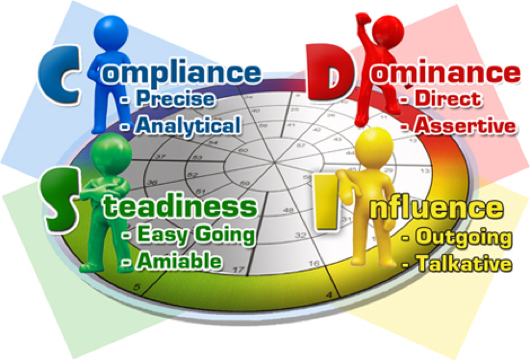
The DiSC tool helps individuals better understand themselves and others in a specific work environment to strengthen team bonding through better understanding of self and others. Participants will receive a DiSC Personalized Assessment that will reveal a person’s natural tendencies and behaviours when it comes to dealing with others and situations in their current work environment.
Your style is usually one dominant and 1 or 2 back-up styles:
• D is Dominant,
• I is Influencer
• S is Steady
• C is Conscientious
In the training you will find this personality profiling training session very helpful to every level of the organizations or even at personal level . After the course, it will be easy to pick out the types of your team members, friends and family members. The workshop not only teaches the four styles, but also teaches how to flex your style and communications to interface better with the other three styles.
It is also a good analystic tool to understand fellow collegues better in task allocation and also during interview session for part timer and full timer recruitment drive.
The course will cover:
Section 1: Behavioural Styles: Theory and Background
- Historical Origins
- Contributing Factors to Behavioural Style
- The Trust Model
- Behavioural Principles/ DISC Model
- Relational orientation verses task accomplishment
- Principles of Motivation
Section 2: Administration of the DISC Personality Profiling System
- What to look out for – The Do’s and Don’ts
- Paper & Pen administration vs Online Administration
- How to Score and Tally
- FAQ on Administration and Scoring
Section 3: Interpretation of the DISC Personality Profiling System
- Characteristics of the High ‘D’, ‘I’, ‘S’ & ‘C’
- What DISC measures
- ‘LOOK’ method of interpretation
- Dominant motivation and fears of each style
- What do the Graphs show?
- Identifying Special Patterns and Blends
- Steps to Graph Interpretation
- How to distinguish between a person’s mask his/ her core self
- How to identify when a person is experiencing stress
- Blends: The ‘D’ blends, The ‘I’ blends, the ‘S’ blends, The ‘C’ blends
Section 4: Application of the DISC Personality Profiling System
- How to Unpack the DISC Report to your client
- Now that I know DISC – What’s Next? – 4 Behavioural Tools
- How Do I Capitalize on my Strengths and Manage My Weaknesses
- Case Study in Personal Relationship, Recruitment, Conflict Resolution,
- Team building and Management
- Personal Growth Areas
- Team Interaction: How to Enhance teamwork among an organization’s staff.

I AM POSSIBLE ! (Charisma Building and Positive Thinking Workshop)
“Charisma is a learnable set of skills which can be built and, when embodied, become a highly desirable characteristic”
A brief internet search will tell you that the word charisma comes from the Greek “kharisma” – meaning “gift,” or “favored by God” and is defined in the Oxford English Dictionary as “compelling attractiveness or charm that can inspire devotion in others.” An in-depth search of the literature will turn up some material on what exactly constitutes charisma, but less useful material on how to develop it. Charisma, personal presence, gravitas, magnetism, ‘that special something,’ there are many ways of talking about the elusive quality that some leaders have which makes people want to follow them. Charisma is a crucial factor for success and without it Obama would not have been elected.
Course outline:
– Projection vs. charisma: Learn the distinction between projected authority and charisma. Some people appear impressive because you know of their social status and project this onto them. Charismatic people on the other hand come across as impressive from the moment you meet them, even if you know nothing about them.
– Health, energy and appearance – The basis of charisma is health. Charismatic people need not have perfect smiles or gym bodies, but they do have a vitality and abundance of life. They also nearly always manage their appearance well. Perhaps it is animal instinct to follow healthy individuals.
– Discover the role of the body – Charisma is an embodied quality. I say this as it is apparent from the moment an individual walks into a room and is the same across cultures. The vocal style and choice of words of course makes a huge impact (Obama also has a great speech writer), but the basis is embodied. When I say embodied, I mean charisma is conveyed by posture and movement and tends to make charismatic individuals attractive in all senses of the word.
– Connection to a higher vision – Charismatic individuals seem connected to a bigger driving force beyond their own gain. Obama inspires hope through his sense of vision and purpose (as did Blair and Thatcher). Brown does not appear to be communicating how he might be in touch with a larger “for the sake of what?”
– Build Self esteem & Presence – Charismatic individuals like themselves and have high levels of grounded confidence.
– Uniqueness – Self Confidence and Charisma is a learnable set of skills which can be built and which, when embodied, become a highly desirable characteristic.
EQ & You
It is critical that leaders learn to lead with emotional intelligence so that they can produce results that are conducive to the organizational goals. This course will help you become a more effective leader – one who is equally good at managing your own emotions, as well as the emotions of others, in order to understand and lead your team towards positive outcomes.
Course Objectives:
At the end of the course, you will be able to:
– Know your EQ & areas for development
– Manage your emotions more effectively
– Recognize & empathize the emotional states of others
– Supervise with social intelligence
Duration: 1/2 day
Course Outline:
– The components of EQ
– The Power of Understanding Emotions – What is Emotional Quotient (EQ)?
– The 5 domains of EQ (Self-Assessment Tool)
– Key competencies of EQ
– Can You Manage Your Emotion
– Explosion or implosion
– Emotion, Response, Behaviours
– Impact on performance
– Impact on Interpersonal relationship
– The power of empathy and building empathy
– Emotional climate assessment of the environment
– Leading with Social Intelligence
– Promote positive environment through EQ
– Building strong bonds of collaboration
– Resolving difficult situation at work
– Conflict resolution from a emotion management
– Perspective
– Embracing change
– Resilience at work
– Apply Physcology at workplace
Methodology: Mini lectures, sharing, group discussions, case studies & written assessments etc.
I am WIRED (Ultimate Online Marketing Workshop) Art of Event and Entertainment Management
An overview of event management, seminar, social gathering and traditional and contemporary banquet menus with an emphasis on quality, quantity, setup, timing, service, event planning, and execution of large-volume cooking and catering. Basic cooking and serving competencies will be reinforced and new skills specific to banquet preparation and serving will be taught.
Introduction
– Introduction to the event industry and
– Planning process for small-mid scale talk, seminar, social events and catering
Event initiation and the event planning context
– Establishing event purpose, budgeting
– F&B planning based on existing menu and food and beverage special request planning
– Creating the event concept
– Event work breakdown structure and establishing event resource needs
– Organisational structures for events
– Operational planning
Implementation
– Schedules, checklists and running sheets
– The role of the event manual
Monitoring, control, shutdown evaluation and knowledge management
– Event monitoring and control tools
– Event shutdown tasks
– Event evaluation processes and tools
Outstation Catering Service
– Prepare for Catering Service
– Co-ordinate pre-event/function activities
– Supervise preparations for event/function delivery
– Check list preparation and supervise transportation and set-up
– Conduct pre-event / function briefing
– Supervise event/function and Serve Food and Beverage According to Event Order
– Clean Up After Service and Supervise post-event/function activities
– Topics to be covered include contemporary American banquets, classical cuisine banquets, hot and cold buffet stations, special events, various styles of service, psychology of service, guest relations, the sequence of service, and professional standards for dining room personnel.